The Feature I'm Still Figuring Out
I built Unplugged to disappear into your life.
That was always the idea. A utility that sits quietly in the background, shows you what you need to know, and gets out of the way. You glance at your watch, see your iPhone battery, and move on. No fuss. No constant checking. Just awareness when you need it.
So it's a little strange that I've been opening the app more than ever.
What I Built
A few months ago, someone requested battery history and predictions on the feature wishlist. Simple enough request. But once I saw it, something clicked.
Up until now, Unplugged solved battery anxiety by telling you what's happening right now. Your phone is at 40%. Your phone is at 20%. Time to charge. That's useful, but it's reactive. You find out you have a problem at the moment you have the problem.
What if instead you could see it coming?
That's what Battery History and Prediction is trying to do. It tracks your battery over time and estimates when you'll need to charge, or when you'll be fully charged. It's not magic—it's pattern recognition. Your battery behaves roughly the same way most days, and that pattern is useful information.
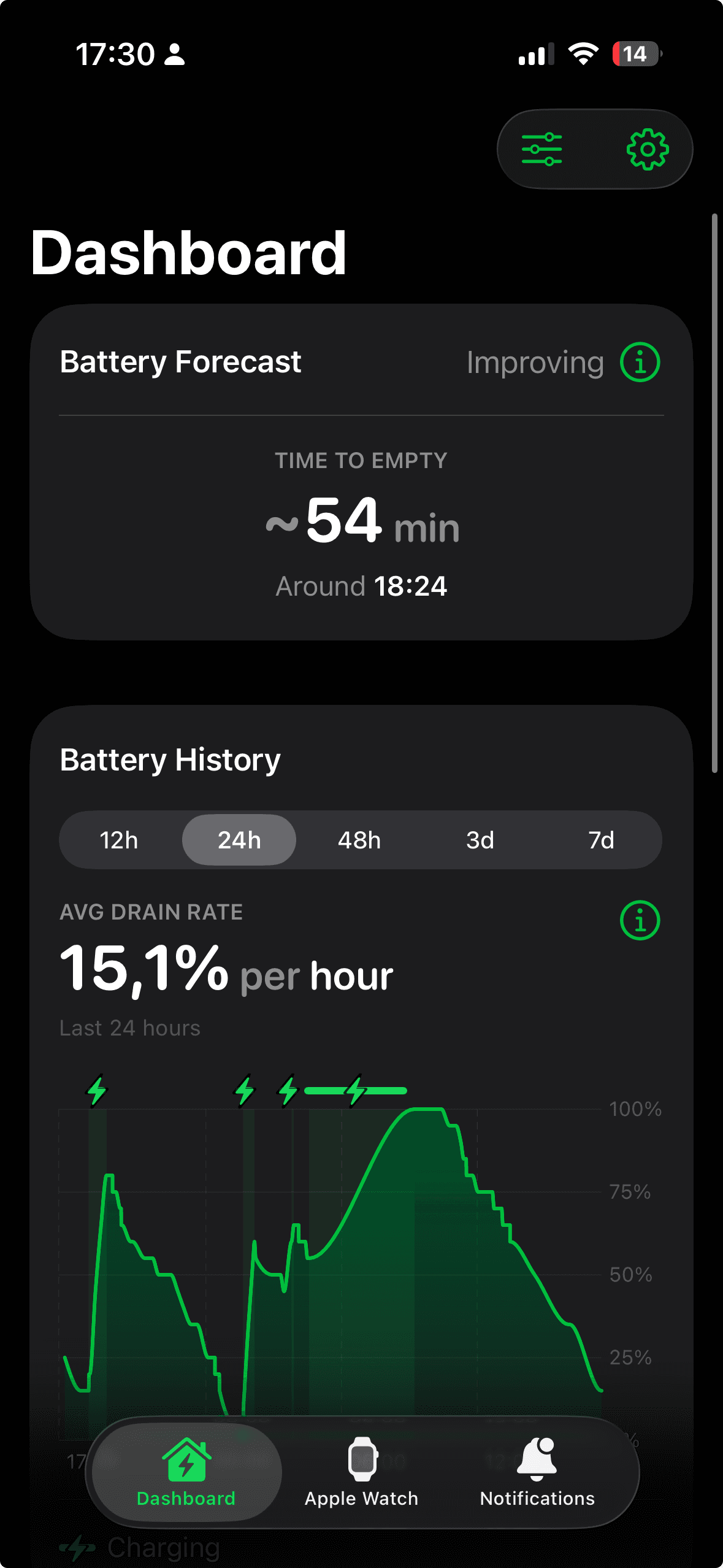
I shipped it a couple weeks ago. And honestly? I don't know if it matters yet.
Cool vs Useful
Early in my career, before I was even a developer, I went through a program that was less about coding and more about product thinking. The lesson they drilled into us was simple: focus on the problem, not the solution.
Sounds obvious. It's not.
What happens—what happened to me repeatedly—is you get an idea that sounds brilliant in your head. You think about it, expand it, imagine all the possibilities. It becomes this whole thing. And then you explain it to someone else and there's just… nothing. No resonance. No "oh, I'd use that." Just polite nodding.
The idea wasn't bad because it was technically flawed. It was bad because it solved a problem nobody actually had.
I've been carrying that lesson ever since. Cool is not the same as useful. Sometimes the simplest features are the most useful, and the most fascinating ones are completely pointless. The difference isn't in how clever the solution is—it's in whether anyone actually needed it.
So now I'm sitting here with Battery History and Prediction, asking myself: is this one of those ideas?
I've been checking the analytics. Daily active users seem to be improving slightly. People who used to drop off after a week might be sticking around a bit longer. Maybe.
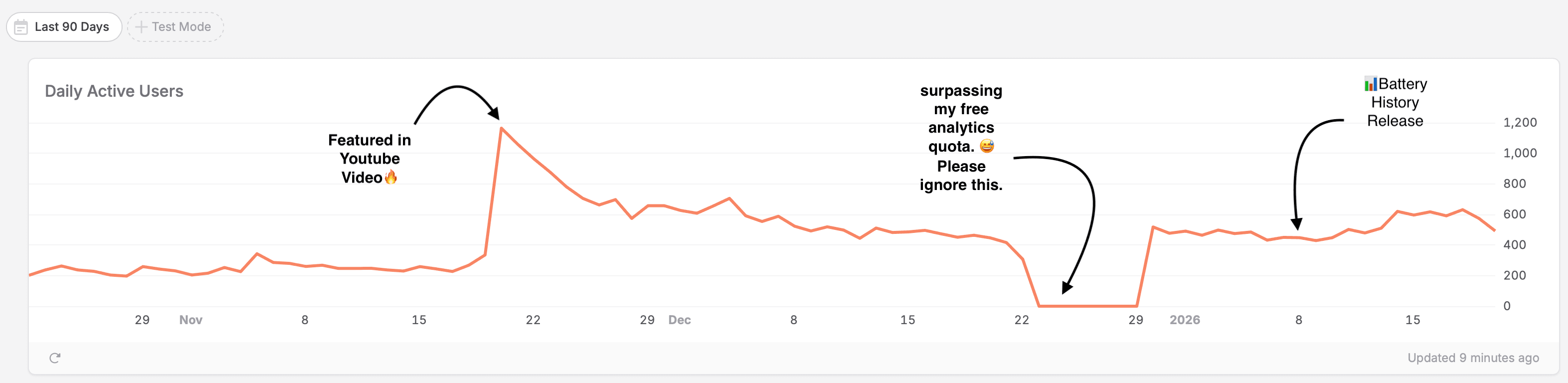
But that doesn't really tell me what I need to know.
The signal I'm looking for isn't a number. It's something more specific: has this feature changed anything about how you think about your battery? Even once? Maybe you saw the prediction and decided to charge before leaving the house. Maybe you noticed a pattern in your history you hadn't realized before. Maybe you just find it interesting to look at, even if you can't explain why.
Any of those would be a signal. Silence is also a signal—just a harder one to interpret.
Where This Could Go
I don't think ideas are precious. Execution is what matters. So I'll share what I see when I look at Battery History and Prediction, and why I'm still figuring out what it means.
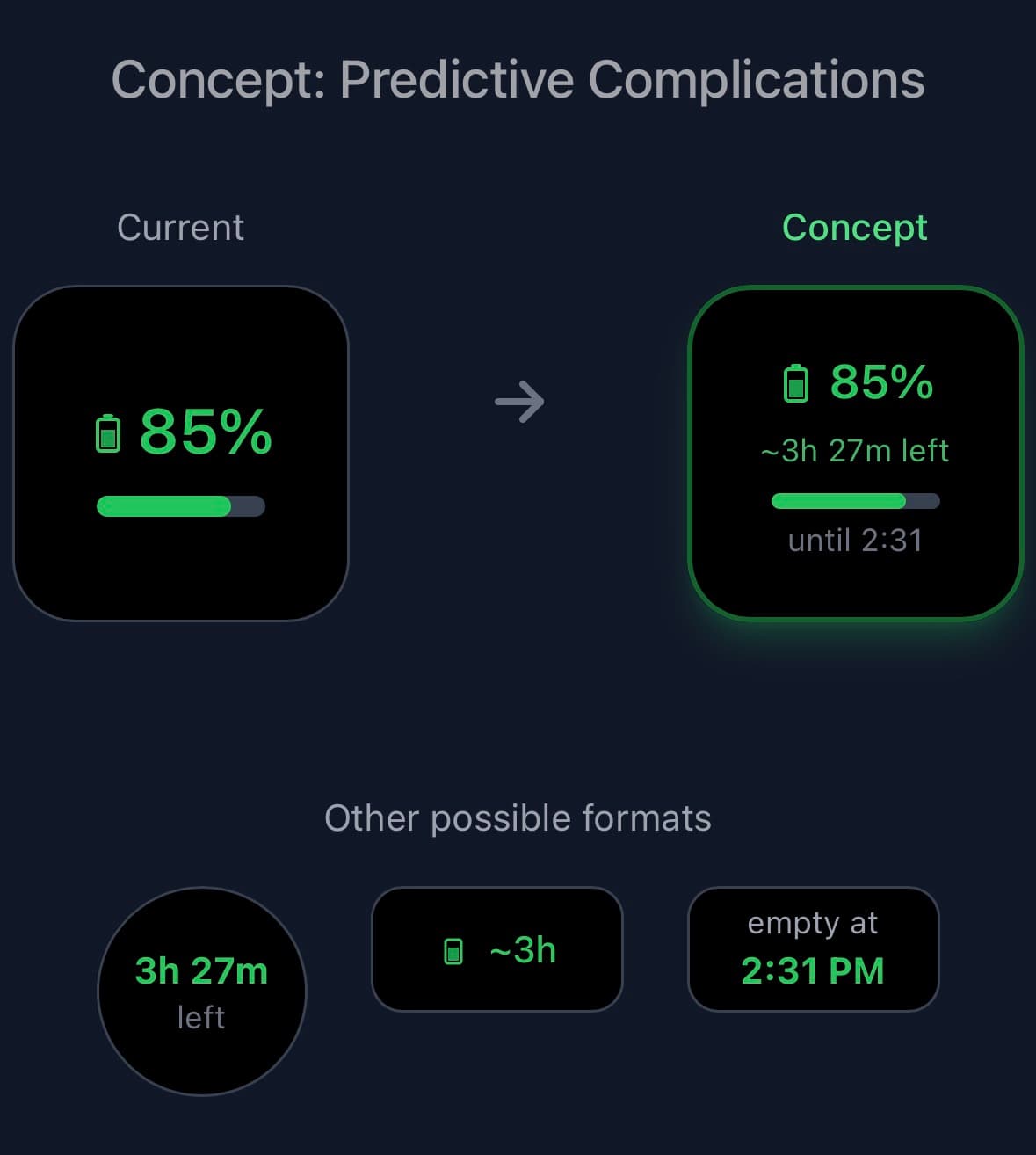
Right now, complications show your current battery level. But what if they could show when you'll need to charge? A complication that says "~3 hours left" or "full by 2pm" would close the loop between the history you're building and the glanceable information Unplugged was designed for. That's the watch-first vision—information that lives on your wrist, no app-opening required. The original dream.
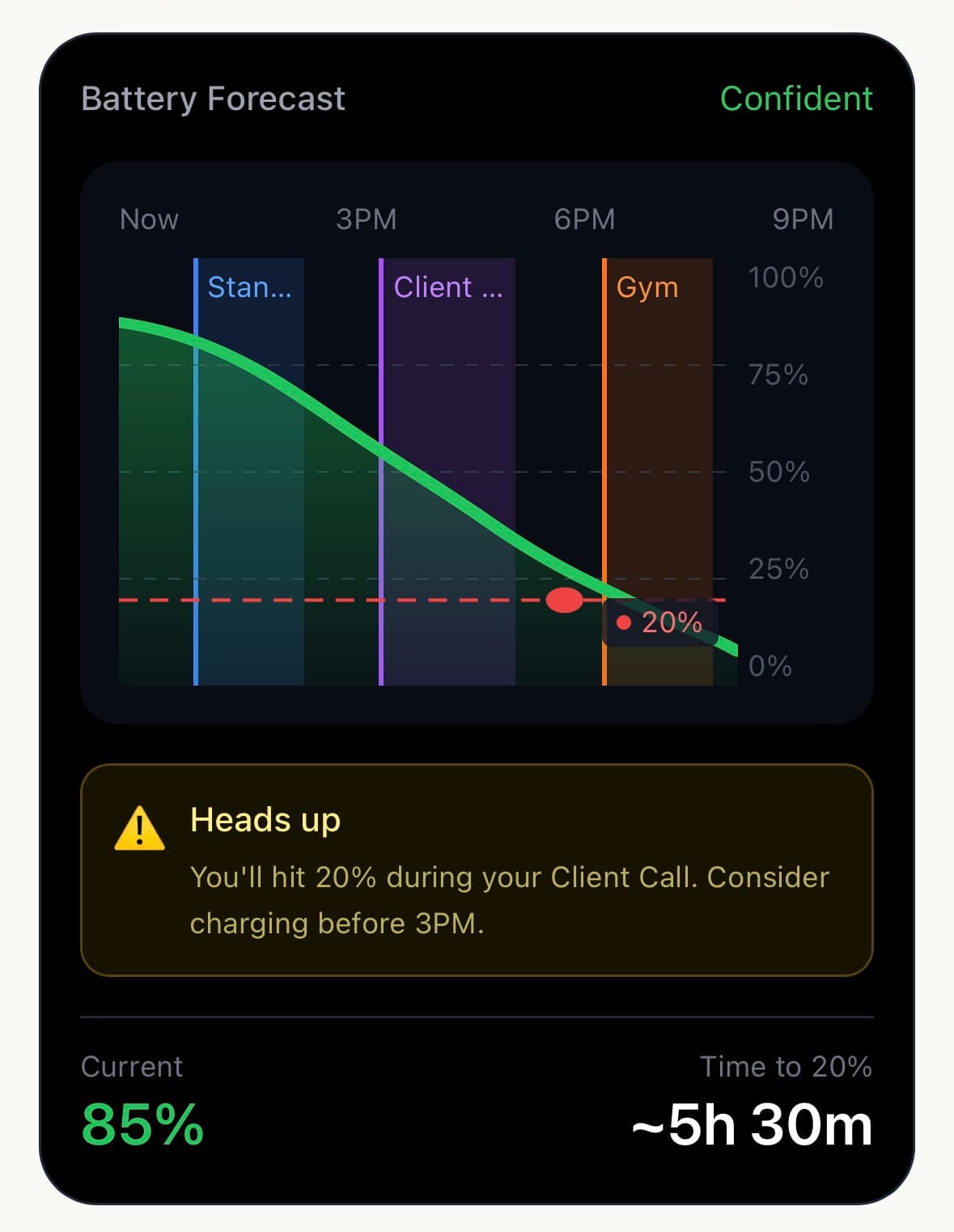
Then there's the phone side. The prediction exists, but it's just a number. Imagine seeing it as a graph—your battery curve projected forward through the day, with your calendar events layered on top. You'd see, visually, whether you'll make it through that afternoon meeting or whether you should find a charger at lunch. That's rich and detailed, but it means opening the app.
And there's contextual insights. The app could learn that Tuesdays are your heavy usage days, or that you drain faster when traveling, or that your battery behaves differently in winter. Those patterns exist in the data. Surfacing them could turn passive awareness into something genuinely actionable.
These directions pull in different ways. The complications keep Unplugged as the quiet utility it started as—glance at your watch, get what you need, move on. The visualizations and insights make it something you actively engage with, something worth opening. Maybe that's fine. Maybe the app can be both. Maybe different people want different things from it.
I don't have a clear answer about what Unplugged is becoming. A watch app? A phone app? A utility that disappears or a tool you return to? Right now, it's a bit of all of these, and I'm not sure yet which direction serves you best.
But I'm not going to build all of that unless the foundation matters first.
Stepping Back
As I mentioned in my last post about where Unplugged is headed in 2026, the next couple of months are focused on stability and accessibility. That was always the plan after shipping this feature—make sure the core experience is solid, revisit the accessibility work I've let slip since the redesign, and build a stronger foundation before adding more on top.
In the background, I'll be watching. Seeing how Battery History and Prediction lands. Looking for signals. Trying to understand whether this is something to keep building on, or whether it's time to explore a different direction entirely.
If you've used it and something changed—even something small—I'd love to hear about it. You can reach me through the app, by email, or on the links below. And if you haven't tried it yet, it's there.
I'll figure this out eventually. Maybe with your help.
Written by Christian Skorobogatow
New features. No spam.
Get notified about new releases and behind-the-scenes updates. Unsubscribe anytime.